How Do You Support a Burned-Out Team Without Burning Out Yourself?

Table of Contents
I. Introduction
II. Why Grief Is Often Hiding Underneath Burnout
III. How To Support Your Team Without Losing Yourself
IV. You Are Allowed to Need Support, Too
V. Building the Skills to Hold This Well
I. Introduction
If you're leading a team right now, there's a good chance you're carrying two kinds of exhaustion: your own, and that of the people on your team. If you are the one responsible for morale, retention, and performance, you can end up absorbing the emotional weight of an entire group while still being expected to show up steady, clear, and encouraging.
This is one of the quieter forms of stress leaders carry — grief for the team culture that used to feel lighter, grief for the energy you used to have, grief for the version of your role that didn't feel like constant triage. Naming that loss is often the first step toward addressing it honestly.
Here's how to support a burned-out team without disappearing into that same exhaustion yourself:
First, Recognize What Burnout Actually Is:
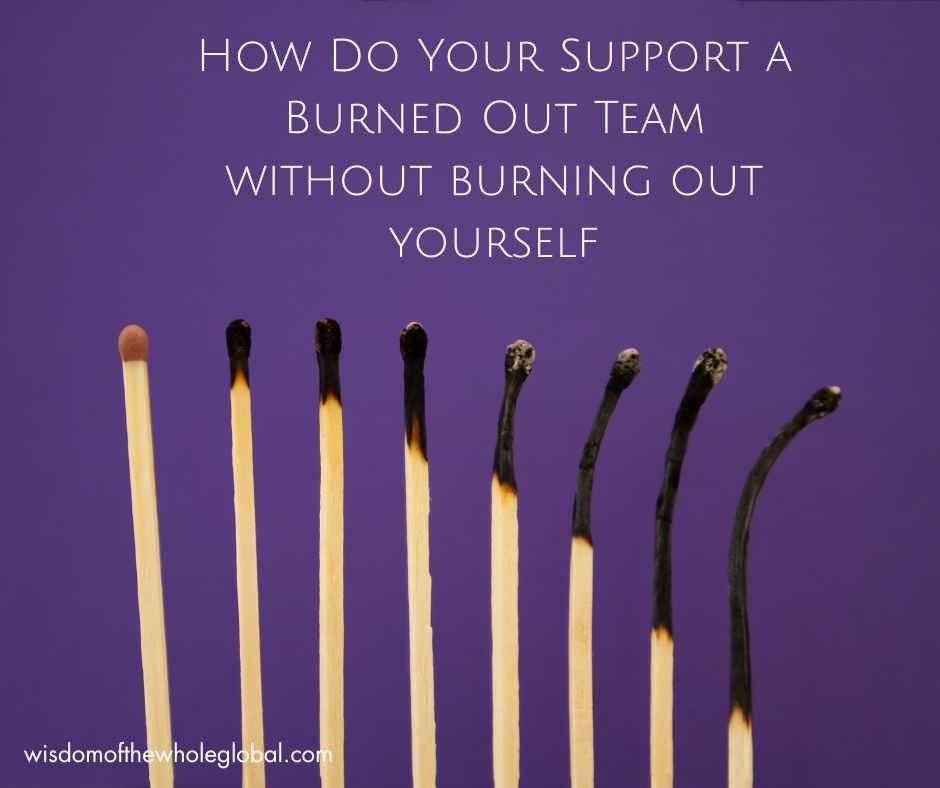
Burnout isn't just "being tired." The World Health Organization defines it as a syndrome resulting from chronic workplace stress that hasn't been successfully managed, marked by three things:
Emotional exhaustion
Cynicism or detachment from the work
A reduced sense of accomplishment or effectiveness
When a team is burned out, you'll often see it before you hear it: shorter tempers, slower responses, more sick days, less initiative, a general flatness where enthusiasm used to be. People stop raising their hands, and meetings have less participation.
Naming burnout accurately — rather than mislabeling it as laziness, low morale, or a "bad attitude" — is the first act of true leadership.
II. Why Grief Is Often Hiding Underneath Burnout
It's worth taking a moment to really consider this because it's easy to miss — believe it or not, a lot of workplace burnout has unprocessed loss sitting underneath it. Teams grieve reorganizing, the departure of a beloved colleague, a shift in mission, a season of layoffs they survived but didn't emotionally metabolize, or simply the loss of a working rhythm that used to feel better.
Grief that isn't acknowledged doesn't go away — it tends to resurface as fatigue, irritability, or disengagement. If you only treat the surface symptoms of burnout (more PTO, a wellness webinar, a pizza party) without acknowledging what your team may actually be grieving, the relief tends to be temporary.
Sometimes the most supportive thing a leader can do is simply say out loud: "I know this year has asked a lot of us, and I know some of what we've lost along the way. I see that.” Acknowledgment is not a fix, but it is often the beginning of shifting into something better.
III. How To Support Your Team Without Losing Yourself
1. Get honest about your own capacity first.
You cannot pour steadiness into a burned-out team from an empty reserve. This isn't a platitude — it's an operational reality. Before you plan any team-level intervention, take honest stock of your own state. Are you sleeping? Are you resentful? Are you dreading Mondays in a way that's new? Your own burnout will leak into every decision you make for your team, whether you intend it to or not.
2. Separate what you can control from what you can’t.
A lot of leader burnout comes from trying to fix things that are structurally outside your control — company-wide policy, budget constraints, decisions made several levels above you. Get specific about what actually sits within your sphere of influence (workload distribution, meeting cadence, recognition, flexibility where you have it) and direct your energy there. Naming what you can't control isn't giving up — it's triage.
3. Make space for people to name what they're feeling.
You don't need to run a therapy session. You do need to create moments where people can say "this has been a hard stretch" without it being treated as a performance issue. This can be as simple as starting a team meeting with a genuine, low-pressure check-in, or as structured as a facilitated conversation about what the team has been through in the last year.
4. Redistribute, don't just encourage.
Telling an exhausted team to "practice self-care" without changing their workload is one of the fastest ways to lose trust. Wherever possible, redistribute tasks, extend deadlines, or temporarily deprioritize lower-stakes projects. Support must show up in the calendar, not just in the language.
5. Protect your own boundaries out loud.
One of the most powerful things a leader can do is model the boundaries they want their team to feel permission to set. If you answer emails at 11 p.m., your team will absorb that as the expectation, regardless of what you say in a meeting. Say plainly: "I'm logging off at 6 tonight, and I'd encourage you to do the same." Modelling boundaries gives others permission to do the same.
6. Know when to bring in outside support.
Sometimes a team's burnout runs deeper than any one leader can address alone — especially when it's tangled up with organizational grief, repeated loss, or a culture that's been strained for a long time. This is where a trained coach can help: someone outside the reporting structure who can hold space for what the team is carrying, without the complicated dynamics of also being their boss.

IV. You Are Allowed to Need Support, Too
If you're the one holding a team together right now, it's worth asking yourself the same question you'd ask a struggling employee: who is checking in on you?
Leaders are frequently the last people to receive support, because they're too busy providing it. But sustainable leadership requires the same replenishment you are trying to offer everyone else. That might look like your own coach, a peer support group, or simply permission to name that this season has been heavy for you too.
V. Building the Skills to Hold This Well
Supporting a team through burnout — and the grief that's often underneath it — is a skill set, not just an instinct. It's part of why more nurses, healthcare leaders, and managers are turning to coach training: to formally build the capacity to hold space for others without losing themselves in the process.
Wisdom of the Whole Coaching Academy's coach training program equips leaders, managers, and health and wellness professionals with the skills and tools to support teams through exhaustion and transition — while learning how to sustain their own wellbeing at the same time. Our next cohort begins October 10th. If you're ready to lead with more capacity and less depletion, we'd love to have you join us.