What Does A Life Coach Actually Do? A Real Answer

Table of Contents
Introduction
What Does a Life Coach Do, Step by Step
What a Life Coach Does Not Do
Life Coach vs. Therapist: What’s the Real Difference
Life Coach vs. Mentor vs. Consultant vs. Friend
What Does a Life Coach Session Actually Looks Like?
Do you Really Need a Life Coach?
How to Find a Legitimate Life Coach
Closing

What Does a Life Coach Actually Do? A Real Answer
I. Introduction
In a nutshell, life coach is a trained professional who helps you get clear on what you want, identify what's in the way, and build a realistic plan to move forward — through structured conversation, accountability, and specific tools — not advice-giving or therapy.
This blog post dives into what that actually looks like in practice: what happens in a coaching session, what a coach does and doesn't do, how it's different from therapy or mentorship, and how to tell if it's something you actually need or want.
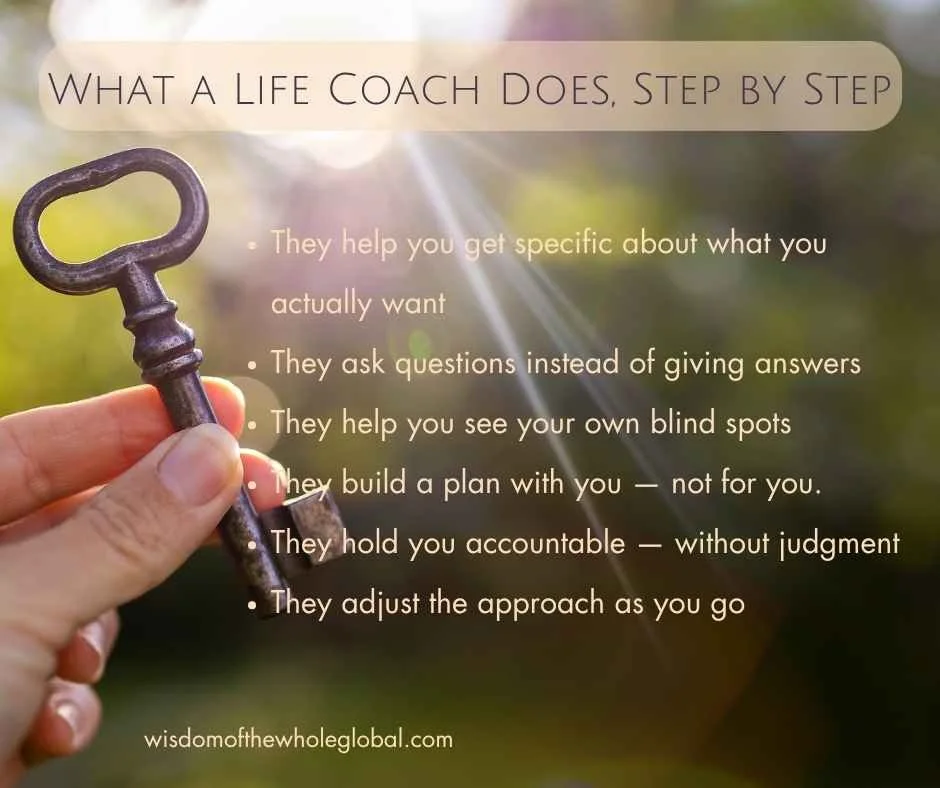
What Does a Life Coach Do, Step by Step
1. They help you get specific about what you actually want.
Most people come to coaching with a vague sense that something needs to change, not a clear goal. A coach's first job is helping you turn “I want things to be different” into something concrete and workable — a specific outcome, a time frame, a definition of what success would look like.
2. They ask questions instead of giving answers.
This is the part that surprises most people. A good coach doesn't tell you what to do. They ask questions designed to surface what you already know but haven't said out loud — about your values, your patterns, your actual priorities versus the ones you think you're supposed to have.
3. They help you see your own blind spots.
Everyone has patterns they can't see from the inside. A coach reflects these patterns back so you can actually work with them, and consider new patterns, instead of running the current ones on autopilot.
4. Coaches build a plan with you — not for you.
Once there's clarity on the goal and any obstacles, a coach helps translate that into action: small, specific, doable steps. The plan is self-determined — the coach's job is to make sure it's realistic and tied to what actually matters to you.
5. They hold you accountable — without judgment.
Between sessions, most coaches check in on progress. Not to shame you if you didn't follow through, but to help you understand why — and adjust. This ongoing accountability is one of the biggest reasons coaching works when willpower alone hasn’t.
6. Coaches adjust the approach as you go.
People rarely change in a straight line. A good coach tracks what's working and what isn't and shifts the approach accordingly — more structure if you need it, more space if you're overwhelmed, a change in focus if the real issue turns out to be something else entirely.
What a Life Coach Does Not Do
A life coach does not diagnose or treat mental health conditions. That's the role of a licensed therapist or psychiatrist.
A life coach does not give you the answers. If someone is telling you exactly what to do in every session, that's advice-giving, not coaching.
A life coach does not focus on your past. Coaching is forward-looking. Even though it might touch on history for context, the work is about where you're going, not processing or analyzing what already happened.
A life coach is not a substitute for medical care. Reputable coaches are trained to recognize when something is outside their scope and a situation requires referral.
Life Coach vs. Therapist: What’s the Real Difference
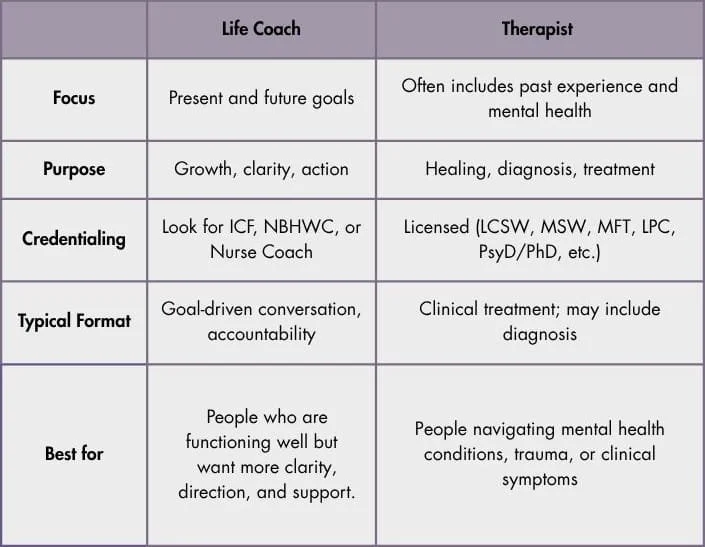
As you can see, therapists and life coaches serve clear, different purposes. Some people work with both at the same time, for different reasons, where both the life coach and therapist are aware of each other as part of the client’s overall wellness plan. A well-trained coach will recognize if what you're describing sounds more like a therapy issue and will say so.
Life Coach vs. Mentor vs. Consultant vs. Friend
A mentor shares their own experience and specific advice, usually because they've walked a similar path. A coach draws out your answers rather than offering their own.
A consultant is hired to solve a specific problem for you, often bringing outside expertise. A coach helps you solve the problem yourself.
A friend listens and empathizes. A coach listens and structures the conversation toward a specific, actionable outcome.
What Does a Life Coach Session Actually Look Like?
A typical coaching session runs 45–60 minutes, usually by video or phone, on a recurring schedule (often every one to two weeks). Sessions generally include:
A quick check-in on what's happened since the last session
Identifying what you most want to focus on today
Structured questions that help you think through aloud
Naming a specific, doable next step
A brief recap of what you're committing to before the next session
Very little of the coach talking about themselves.
Do you Actually Need a Life Coach?
Coaching tends to be the most useful when you're functioning well, but feel stuck, unfocused, or like you're just going through the motions. It can be for when you know what you want to change but haven't been able to make it happen on your own, or when you want structured accountability, and not just another self-help book. Coaching can also be well-suited for navigating a transition — career, health, relationships, identity — and you want a professional who isn't emotionally entangled in the outcome. So, when you think about “What does a life coach do?”it probably isn’t the right fit if you're dealing with a mental health crisis, active trauma, or symptoms of a clinical condition — those are situations for a licensed therapist.
How to Find a Legitimate Life Coach
Coaching is an unregulated industry, which means “life coach” can be a certified professional with hundreds of training hours, or someone with only a business card. A few things worth checking before you hire someone:
Certification — look for a coach certified by a recognized body such as the International Coaching Federation (ICF) or the National Board for Health & Wellness Coaching (NBHWC), or someone who is a Board Certified Nurse Coach (through the AHNCC).
Niche — coaches often have niches such as career coaching, health coaching, executive coaching, life transitions, etc. A coach with extensive experience in your specific area will ask sharper questions.
A real intro conversation — reputable coaches usually offer a discovery call before you commit, so you can understand if the coach is right for you before paying for a series of meetings.
Clear boundaries — a good coach will have you sign a coaching agreement outlining exactly what the coaching package entails, and what it does not, including number and length of sessions, how you will meet, fees, etc.
Clear scope of practice — for example, a coach who says “that sounds like something to bring to a therapist” is a good sign, not a red flag.

Closing
Now that we’ve answered the question “What does a life coach do?”, you can better decide if having, or even becoming a life coach, is right for you. If you would like to find a coach to work with, our Wisdom of the Whole coach directory can be found here. If you would like to see coaching in action, join our next free call here.