What Is After Certification, If Not A Coaching Practice?

Table of Contents
Introduction
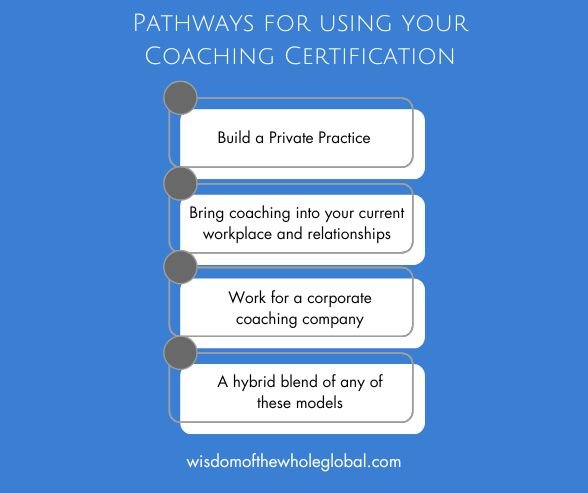
Path 1: Build a Coaching Practice
Path 2: Bring Coaching Into the Work You Already Do
Path 3: A Blend of Building a Coaching Practice and Bringing Coaching into Your Current Work
Path 4: Get Hired as a Corporate Coach
Which Path Is Right for You?
Introduction
Once you obtained your coach training and certification, maybe you pictured yourself in private practice — launching a website, getting a client roster — the whole deal. But now that the training is over, that picture feels a bit daunting. Or, maybe you never wanted business to begin with. Maybe you came to the coach training because you wanted to be a better leader, a better parent, a better nurse, partner, teacher, consultant, or friend — and somewhere along the way you started wondering if that's still considered a “coach” or if it means your training wasn’t put to it’s best use.
At Wisdom of the Whole, we believe coach training isn't a single door that leads to a single room. It's a set of skills — presence, active listening, powerful questions, the ability to help someone find their own next step — all of that can live in almost any container you choose. Building a coaching practice is one way to use your skills, but it’s not the only one, and it isn't automatically the “right” one for everyone.
We will walk through a few potential paths forward — including the one nobody talks about — where you don't start anything new at all, but simply change how you show up in the work you're already doing.

Path 1: Build a Coaching Practice
If this is genuinely what you want, let's name that clearly first: it's a real, viable, deeply rewarding path, and plenty of our graduates do exactly this.
But "build a practice" is a vague instruction, so here's what it actually breaks down into:
Finding your niche. For example: ”I coach nurse managers navigating burnout,” or "I coach new parents returning to leadership roles.” Your own life experience is usually the fastest route to a niche — what have you already lived through that others are currently living through?
Get your first clients before your website is perfect. Offering a few free or low-cost sessions can help you build a client base and improve word of mouth.
Decide how you actually want to work. For example: one-on-one coaching sessions, group coaching, workshops, retreats — these require different business structures and it's important that you are happy with the structure and rhythm you are working within.
Give it time, and stay curious to keep your practice evolving. If you run into challenges, it’s not a signal to quit; it's the normal process of building something from nothing.
(Stay tuned for a deeper dive on building your practice in our next blog post.)
Path 2: Bring Coaching Into the Work You Already Do
This is the path we think doesn't get talked about enough — and it's often the one that changes someone's day-to-day happiness the fastest, because it doesn't require starting from zero. You don't need the title "coach" to coach. For example, coaching skills transfer directly to the work that managers and team leads do on a daily basis. You can ask open-ended questions and engage in active listening before jumping to solutions and advice. This opens up a rich dialogue between colleagues that is solution oriented — where together, you can solve long-standing problems.
Teachers and school administrators can also use their coaching presence to shift conversations with students and parents from correction to genuine partnership. Healthcare providers can utilize their coaching skills to bring the patient into conversations that used to feel like they were leaving the patient out, and then not getting anywhere with treatment. Human Resources and Leadership and Development make performance conversations more interactive and solution oriented, and less one-sided and problem focused. Consultants, project managers, and executives find that a single well-placed coaching question can do more to unblock a stuck meeting than an hour of problem-solving.
The shift here isn't external — nobody actually needs to know you did a coaching certification for this to work. All you are doing is showing up differently with your presence and in conversations you were already having. For a lot of our graduates, this is where the real relief comes in — you feel like your training really did something to shift your work culture and work satisfaction without taking on the second job of running a business.

Path 3: A Blend of Building a Practice and Bringing Coaching into Your Current Work
Plenty of people don't pick one path and stay there. A common pattern we see is that graduates start by bringing coaching into their current role while slowly developing their private practice. Perhaps they get a handful of clients on evenings and weekends while their day job provides stability. You can decide over time whether or not you want to make your private coaching business your full-time work, or retire from your current job and transition to a part-time private practice.
Once you determine the blend that is right for you, it will be something that energizes you, feels right, and sustainable in the long-term.
Path 4: Get Hired as a Corporate Coach
A growing number of our graduates are stepping into coaching roles inside established companies — organizations that have built internal coaching programs for their employees, leadership teams, or clients, and are actively hiring certified coaches to run them. These are positions with salaries, benefits, and a team around you, at companies that range from wellness platforms and healthcare organizations to Fortune 500 HR departments.
This path has become one of the more surprising outcomes because most people enroll in coach training expecting to eventually build their own practice — not to walk into a stable, well-paying job. But a recognized coaching certification is often the exact credential that companies require in order to apply, which means your coach training becomes the door-opener. For graduates who want the fulfillment of coaching without the uncertainty of building a client base, working in-house at an established company may be a faster, steadier, and comfortable path into the field than expected.
Which Path Is Right for You?
Here are some coaching questions to ask yourself:
When you imagine yourself one year from now, does the version of you with your own coaching business feel like relief, or like pressure?
Has there been a conversation within the last week at your current job where a coaching approach could have changed the outcome?
What does it feel like in your body when you imagine your role as a coach within an established organization making a salary, benefits, and working in a team environment?
What would it mean to give yourself permission to not decide on your specific coaching path yet?
As much as you might like immediate and/or drastic change in your work after you obtain your coaching certification, It’s good to remember that your coaching skills are something you now carry with you at all times, and you don’t have to wait to use them — you can apply them in meetings, classrooms, hospital rooms, family dinners, or board rooms, and everything in-between. Whether you use your skills to build something entirely new, or to be more present in the work you already do, you are coaching, and you are creating transformation.
If you're a Wisdom of the Whole graduate figuring out your own next step, we'd love to hear from you. Share your story with us here.