How to Start Your Coaching Practice After Certification

How to Start Your Coaching Practice After Certification: The Foundations
Table of Contents
Introduction
Start With Who, Not What
Get Your First Clients Before Your Website and Systems are Perfect
Decide How You Actually Want to Work
Begin to Consider the Logistics of Your Practice
Set Realistic Expectations for Timeline
One Thing to Remember

Introduction
If you read our blog post on What is After Certification if Not a Coaching Practice?, you will know that we don't think building a private practice is the only way forward after completing your coach training. However, if you think a private practice is the path you want (and not the one you feel obligated to want) — here is a place to start.
Building your own coaching practice doesn’t have to be complicated. It's a handful of decisions, made in the right order, followed by small, steady, consistent steps. We hope you enjoy this guide as a way to spark your own ideas and start your coaching practice in a way that is best for you.

Start With Who, Not What
The most common stall point for new coaches often has to do with trying to describe what they do in the abstract, for example: "I help people find clarity,” instead of describing more specifically who they help, and with what.
Here are four steps to find your niche instead of guessing at one:
Look at your own defining life experiences. What have you already lived through, deeply enough that you understand it inside and out? Was it a career change, a health crisis, becoming a parent, leaving a toxic workplace, or starting over in midlife? Your lived experience is usually a faster path to finding a niche than anything else.
Look at who already gravitates toward you. Who comes to you for support, unprompted? That pattern can tell you where people already sense you have something to offer.
What are your qualifications and scope of practice? Write down all of your education and training alongside what each of those qualifies you to do. This will help you start outlining the foundation for your niche.
Form a picture of your niche from your life experiences, audience, and qualifications — get specific enough that it feels almost too narrow. For example: ”Career coach" as a niche is crowded and vague. "Career coach for people leaving a 15+ year corporate career to start something of their own" is specific enough that the people most aligned with this niche description feel seen immediately.
You can always widen a niche later once you have feedback from clients and get a sense of what is really working and what isn’t.

Get Your First Clients Before Your Website and Systems are Perfect
This is the step where new coaches can get stalled because a polished website with zero visitors generates zero clients, not to mention that it can be a big expense. However, a rough offer sent to five people who already know and trust you generates conversations, and client leads.
Realistic ways to find your first clients:
A small number of low-cost or free coaching sessions offered specifically in exchange for a testimonial you could use in your marketing materials. Three to five testimonials are usually enough to generate real feedback, and these are your first pieces of proof that you are who you say you are, that you get results, that you are great to partner with. A testimonial may help someone who is on the fence about signing up feel more confident to do so.
Have clear, simple offerings — not so many options that it might be confusing for someone to sign up. One or two clear offerings makes it easy for someone to say yes.
Show up in one place consistently — a LinkedIn post, a newsletter, a local community group, etc. — rather than trying to be on multiple platforms at once. Consistency in one channel beats sporadic effort across five, and you can choose the one that you like best.
Decide How You Actually Want to Work
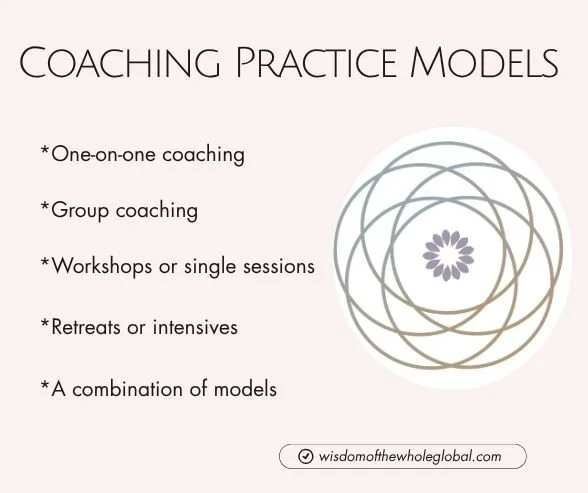
A coaching practice isn't one business model, and it’s important that you find one that is right for you. For example:
One-on-one coaching — the most familiar model, built around individual sessions over weeks or months.
Group coaching — where a cohort moves through a program together — more scalable, and often better for coaches who enjoy facilitation and peer dynamics as much as one-on-one depth.
Workshops and single-session offerings — useful for reaching more people at a lower commitment level and often a good entry point before someone books deeper 1:1 work with you.
Retreats or intensives — higher-touch, higher-price, usually built once you already have an audience or client base. Retreats can also include specific themes that highlight or showcase your niche.
The model (or combination of models) you choose should fit your energy and your life, not just a perceived industry standard.

Begin to Consider the Logistics of Your Practice
In addition to finding your initial clients and setting up a business model, here are a few details to consider regardless of your private practice style:
How will you be paid (what forms of payment do you want to accept and how?)
How do your clients schedule with you? (A simple calendar system is fine to start but you may want to consider leveling up with a scheduling app)
What will your coaching agreement look like? (It is important to set expectations and provide clarity on what you do and do not offer.)
Where will you practice (virtually, by phone, in person)?
Of course, payment systems, scheduling, coaching agreements, and all the logistics and technology surrounding building a practice are well beyond the scope of a single blog post. When you are ready to start your coaching practice, there are many great resources out there to assist small businesses like SBA.gov and SCORE.org.

Set Realistic Expectations for Timeline
Your coaching practice will likely not feel sustainable after the first few months. That's not a sign to quit — it's typically what happens when you build something from nothing.
In our experience, here is a general, realistic timeline to start your coaching practice:
Months 1–3: Mostly setup, first low-cost clients, early testimonials. Income is minimal. This is normal.
Months 4–9: First paying clients at a real rate, first referrals starting to trickle in, some clarity emerging about what's working.
Months 10–18: The practice starts to feel like an actual business — repeatable offer, some predictability, enough evidence to make bigger decisions (going full-time, raising rates, expanding further).
If you're building this alongside other work, the timeline stretches — and that's a feature, not a failure. A practice built slowly, on real evidence of what's working, tends to last longer than one built fast on urgency.
One Thing to Remember
You don't need to have all of this figured out before you start. Decide on a niche specific enough for people to find you, provide a first offer simple enough for someone to say yes to, and have enough patience to let evidence — not anxiety — tell you whether or not your system is working.