7 Everyday Coaching Techniques to Shift into Your Best Life

Table of Contents
I. Introduction
II. What Is “The Shift” — and Why Does It Matter?
III. 7 Everyday Coaching Techniques to Create Your Own Shift
IV. What Happens When The Shift Becomes a Way of Life
V. Who Benefits Most from These Coaching Techniques?
VI. What If You Could Help Others Create These Shifts?
VII. The Science Behind The Shift
VIII. Starting Today: Your Personal Shift Practice
IX. Ready to Learn to Coach The Shift?

I. Introduction
There is a moment in every meaningful transformation that coaches refer to as “The Shift”. It’s the moment when something really clicks for a client and new possibilities flood in. This is one of the reasons why our coaches do what they do — and just happens to be one of the most powerful International Coaching Federation (ICF) Core Competencies: Evoking Awareness.
What if you didn't have to wait for a one-on-one coaching session to experience that kind of shift? What if you could weave these same transformative coaching techniques into your Tuesday morning, your difficult conversation, or your moment of self-doubt at 3 a.m.?
At Wisdom of the Whole Coaching Academy, we believe that coaching isn't just a profession but also a way of being. The everyday application of coaching skills and tools is one of the most powerful paths to living a whole, purposeful, and deeply satisfying life. Whether you're a seasoned professional, a nurse leader, a teacher, an entrepreneur, or simply someone who knows there's more to discover in yourself, these techniques are for you.

II. What Is “The Shift” — and Why Does It Matter?
In the International Coaching Federation (ICF) framework, the competency of Evoking Awareness describes a coach’s ability to facilitate new insights in the client. It’s the art of asking questions, offering observations, and holding space in a way that allows a person to see their situation, their patterns, and their possibilities from a completely new vantage point.
In ICF’s research into what makes coaching transformational, hundreds of “critical incidents” were identified — moments when clients experienced a positive shift in perspective, energy, belief, or understanding. The spark for each of those shifts could have been a well-placed question, a moment of silence, a reflection offered with compassion, or a new way of framing a long-held story.
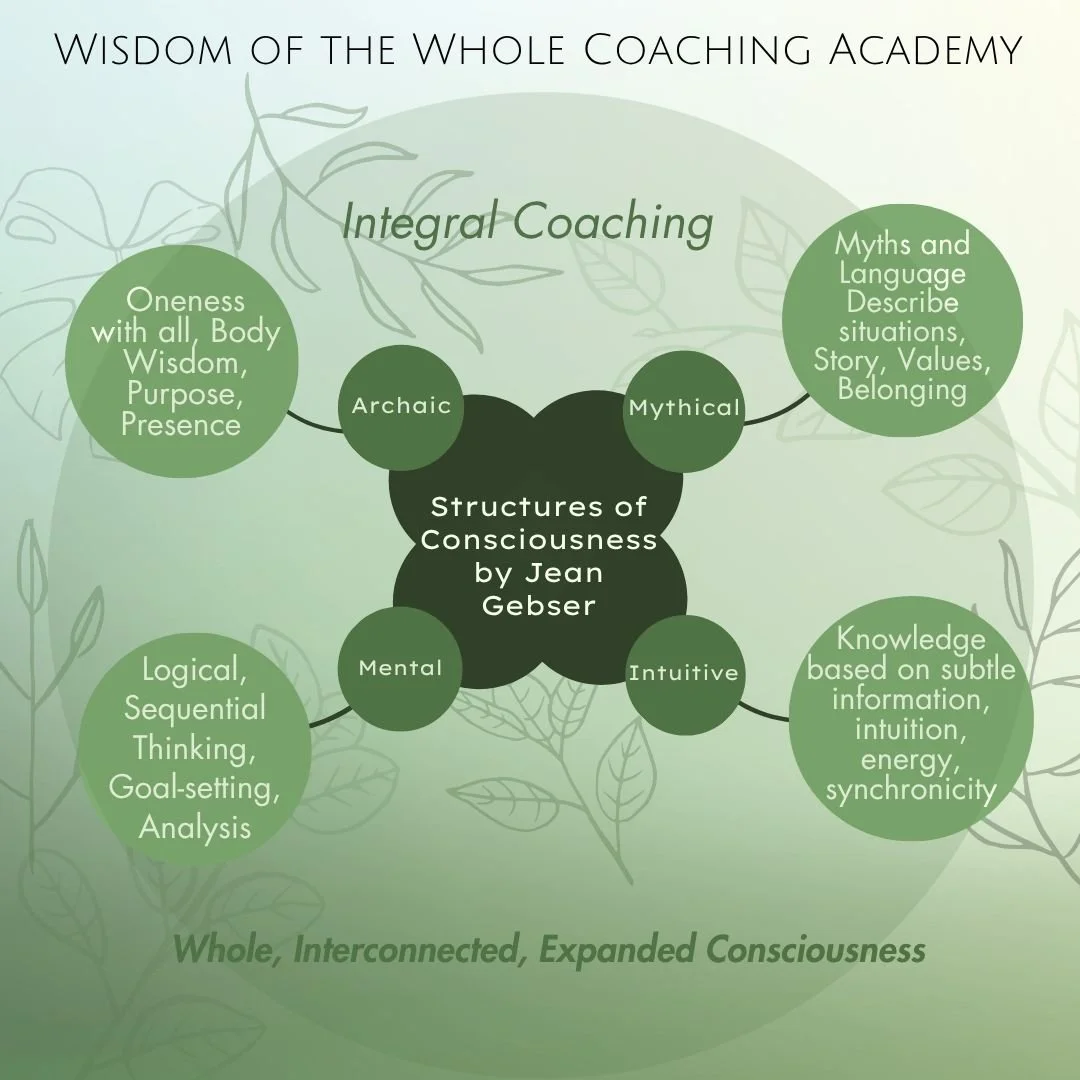
The Shift is not just an insight — it’s a reorganization of how you see yourself in the world, and the beginning of lasting change. At Wisdom of the Whole, our model goes even deeper. With a foundation in Jean Gebser’s Five Structures of Consciousness, we teach coaches to facilitate shifts not just at the mental or cognitive level, but across the full spectrum of human experience: mental, mythical, magical, archaic, and integral. This whole-person, whole-being approach moves clients toward their goals more quickly, authentically, and sustainably — often eliminating the false starts that come from working only at the surface.
The everyday coaching techniques below draw on all five of these dimensions. You don’t need to be a certified coach to start using them — these will give you a direct taste of what it feels like to be coached from the inside out.
III. 7 Everyday Coaching Techniques to Create Your Own Shift
The Powerful Question Pause
At the heart of Evoking Awareness is the powerful question — something that opens things up for a client, explores with curiosity, and invites an authentic answer. In professional coaching, powerful questions are one of the primary vehicles for creating shifts in awareness, but you can ask them yourself, right now.
The key is to slow down before reacting, deciding, or judging, but instead pause to ask yourself a question that comes from genuine curiosity. Not “What’s wrong with me?” but “What do I really want?” Not “Why can’t I figure this out?” but “What do I need to move forward with confidence?” These questions bypass the inner critic and invite the deeper, wiser self to the conversation.
Try this today:
When you notice you are stuck, stressed, or spinning in a loop, stop and ask, “If I already had the answer, what would it be? Sit with the silence and pay attention to new thoughts, images, and body sensations that arise.
2. Multi-Level Listening (Beyond the Words)
One of the most transformative coaching skills — and one of the most underused life skills — is listening on multiple levels. Most of us listen to respond, however coaches learn to listen to understand, and to hear what is not being said as much as what is being said.
In the Wisdom of the Whole model, multi-level listening includes attending to the words, the emotions, the body language, the energy, and the deeper story beneath the surface. When you practice this in your own life, the quality of every relationship, conversation, and decision changes. For self-directed use you can practice listening to your body. Your body often signals misalignment, excitement, grief, or knowing long before your mind catches up.
Try this today:
In your next conversation, commit to one full minute of pure listening — no planning your response, no judgment. Simply take it in. Notice what you discover that you would have otherwise missed.
3. The Reframe: Changing Your Story, Changing Your Life
One of the most remarkable things a skilled coach does is help a client see their story from a new angle — not to minimize or invalidate their experience, but to reveal what else might also be true. This is called reframing, and it is a foundational technique for creating The Shift.
We all walk around with narratives about ourselves and our world that shape what we believe is possible. “I’m not a creative person,” or “People like me don’t get opportunities like that,” or “It’s too late for me to change.” These stories feel like facts, but they are interpretations…and interpretations can be updated. The reframe asks: “What else could this mean?”
Try this today:
Identify one story you carry about yourself that feels limiting and write it down. Then write three alternative interpretations of the same experience — ones that are equally true, but that leave you feeling more empowered and open.
4. Values Alignment Check: Are You Living Your Truth?
A significant portion of the stress, restlessness, and dissatisfaction people experience comes not from external circumstances, but from a misalignment between how they’re living compared to what they most deeply value. In coaching, reconnecting to core values is one of the fastest paths to clarity and to The Shift.
At Wisdom of the Whole, we believe that when you understand and acknowledge your values and make choices aligned with them, life becomes less effortful and more energized. Values alignment is a daily practice — a quiet checking-in that asks: “Is the way I’m spending my energy today reflective of what matters most to me?"
Try this today:
Identify your top three core values (examples: personal connection, creativity, integrity, growth, freedom, service). At the end of today, ask: “Did I honor each of these in some way?” Notice where you did, and where you want to honor them tomorrow.
5. Somatic Awareness: Your Body as a Compass
Our body is the oldest and wisest intelligence we carry. Holistic coaches understand that the body holds knowledge the analytical mind cannot always access. This could come up as a tension in the shoulders before a difficult conversation, a sinking feeling when you say yes but mean no, or the lightness and ease that signal you’re moving in the right direction.
Somatic coaching techniques (ie. techniques that work with body-based awareness) are embedded in advanced coaching tools at Wisdom of the Whole. They help clients tap into a layer of intelligence that accelerates transformation in ways that purely cognitive approaches cannot. Tuning into your body’s signals isn’t mystical, it’s neuroscience. The gut-brain connection, interoception, and embodied cognition are well-researched pathways to better decision-making and greater self-awareness.
Try this today:
Before making a decision on something you are wrestling with, take three slow breaths. Scan your body from head to toe. Where do you feel ease? Where do you feel contraction? Let those signals be part of your information — not the only information, but a valid voice in the conversation. What does that voice have to say?
6. Visioning: Activating the Future You
One of the most consistently powerful techniques in holistic coaching is guided visioning or imagery — the practice of vividly imagining a desired future as if it is already real. Visioning isn’t wishful thinking. When done with intentionality and sensory detail, it activates the same neural pathways as lived experience, making the future feel achievable and the steps toward it feel natural.
In the Wisdom of the Whole model, visioning draws on the realm of imagery, intuition, and the felt sense of possibility. Coaches use visioning to help clients get out of the problem space and into the solution space — to feel, in their body and mind, what it will be like when they have already achieved their goal.
Try this today:
Find 5 quiet minutes where you can safely close your eyes. Imagine it’s one year from now, and you are living your best life. See it, feel it, use all five of your senses. What are you doing? Who is with you? How does your body feel? Let the vision be vivid and specific. Then write down three things you notice.
7. Compassionate Accountability: The Bridge Between Insight and Action
Shifts in awareness are profound, but they only become transformation when they are followed by action. One of the most important roles a coach plays is holding compassionate accountability — acknowledging the courage it takes to change while also lovingly holding the client to their commitments.
Self-compassion is essential here — it is what enables people to recover quickly from setbacks and maintain long-term motivation. Remember, the inner coach is a kind one, and a clear one. You can bring this into your own life by making clear commitments to yourself and treating those commitments with the same respect you’d extend to an agreement with someone you deeply admire.
Try this today:
Choose one small action that, if you did it, would help move you toward your best life. State it clearly: “By [date], I will [specific action].” Write it down, and consider telling someone you trust.
IV. What Happens When The Shift Becomes a Way of Life
Each of the coaching techniques above creates moments of expanded awareness, but the real transformation happens when these moments accumulate and the powerful questions become your natural internal dialogue, when values alignment becomes a daily compass, when somatic awareness guides your choices, and when compassionate accountability becomes how you relate to your own growth.
This is what whole-person coaching is built to do — not to fix what’s broken, but to cultivate a way of being that is increasingly coherent, alive, and aligned with your deepest nature. It is what Wisdom of the Whole means by integral and holistic coaching — working across all dimensions of the human experience, not just the thinking mind.
V. Who Benefits Most from These Techniques?
These coaching techniques are incredibly versatile. If you are a healthcare professional you’ll find they deepen your patient relationships and help prevent job burnout. If you are a leader or manager, powerful questions and multi-level listening transform team dynamics. If you are a teacher or educator, they can help you meet students where they are and facilitate genuine growth. Any human being who knows there is more richness, purpose, and joy available in this life can use our techniques to help them find it.

VI. What If You Could Help Others Create These Shifts?
If reading this has stirred something in you — a recognition, excitement, a sense of “this is what I’ve been looking for” — then we invite you to consider becoming a holistic coach.
Our Wisdom of the Whole® flagship program has been created, tested, and refined over three decades of practice and is the first and only single coaching program that meets and exceeds the coach training requirements for all three (ICF, NBHWC, and AHNCC) certification pathways (in addition to the Wisdom of the Whole® Coach Certification).
Classes are offered three times a year, with limited enrollment to ensure the highest quality learning experience. Our next cohort begins early June.

VII. The Science Behind The Shift
These aren’t just inspiring ideas, they are backed by research. Neuroplasticity research confirms that the brain rewires itself in response to new experiences, new questions, and new perspectives. Positive psychology research demonstrates that focusing on strengths and possibilities leads to greater resilience and life satisfaction. Mind-body research shows that somatic awareness improves emotional regulation and decision-making. In addition to this, ICF’s own research confirms that the competency of Evoking Awareness is the most consistent predictor of transformational client outcomes.
Wisdom of the Whole integrates this evidence-based research with intuition, somatic techniques, energy awareness, spiritual intelligence, and the wisdom of Jean Gebser’s Structures of Consciousness — creating a coaching model that is both rigorously grounded and whole.
VIII. Starting Today: Your Personal Shift Practice
You don’t need to overhaul your life to begin shifting it. You might only need one new question, or one moment of somatic check-in. Perhaps one values-aligned choice, or one vision held with belief and warmth. You can start small, stay consistent, and trust that each shift is reorganizing the architecture of your life in ways that compound over time.
The world needs people who are awake, aligned, and authentically themselves. People who ask thoughtful questions, listen more deeply, act with more intention, and lead from a place of genuine wholeness. This is what coaching cultivates — within coaches themselves and in the people they serve.
Your best life isn’t somewhere “out there,” but is available in the next moment of awareness. It can be in the next question you ask yourself, or in the next breath you take with full presence and intention — that is The Shift, and it begins now.
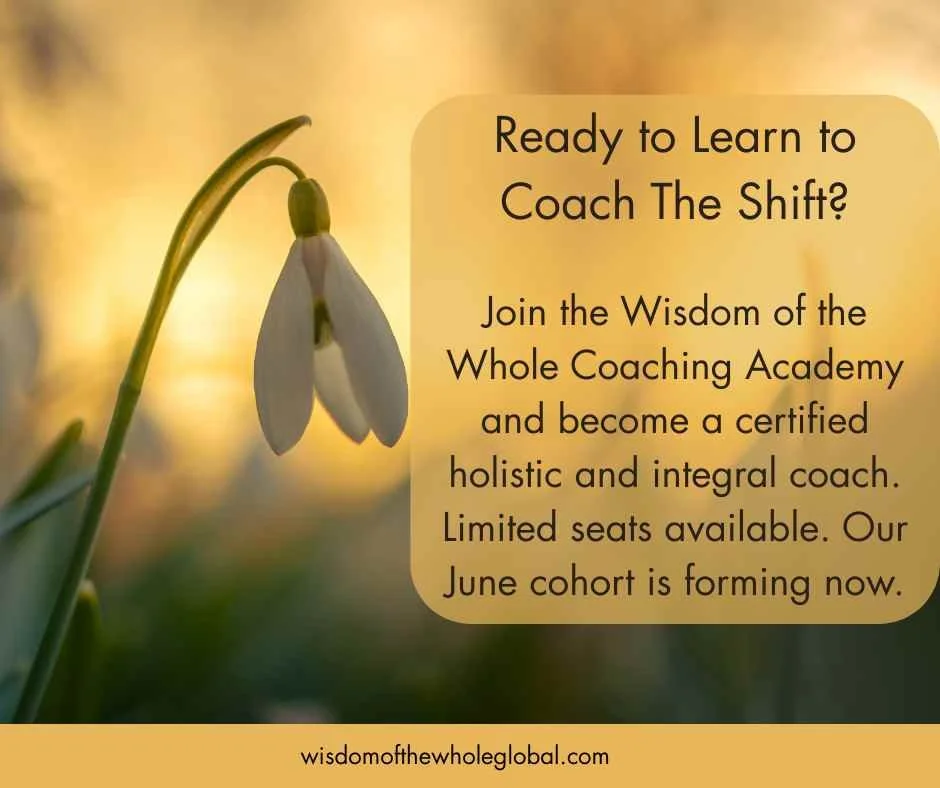
IX. Ready to Learn to Coach The Shift?
Join the Wisdom of the Whole Coaching Academy and become a certified holistic and integral coach. Limited seats available. Our June cohort is forming now: wisdomofthewholeglobal.com